
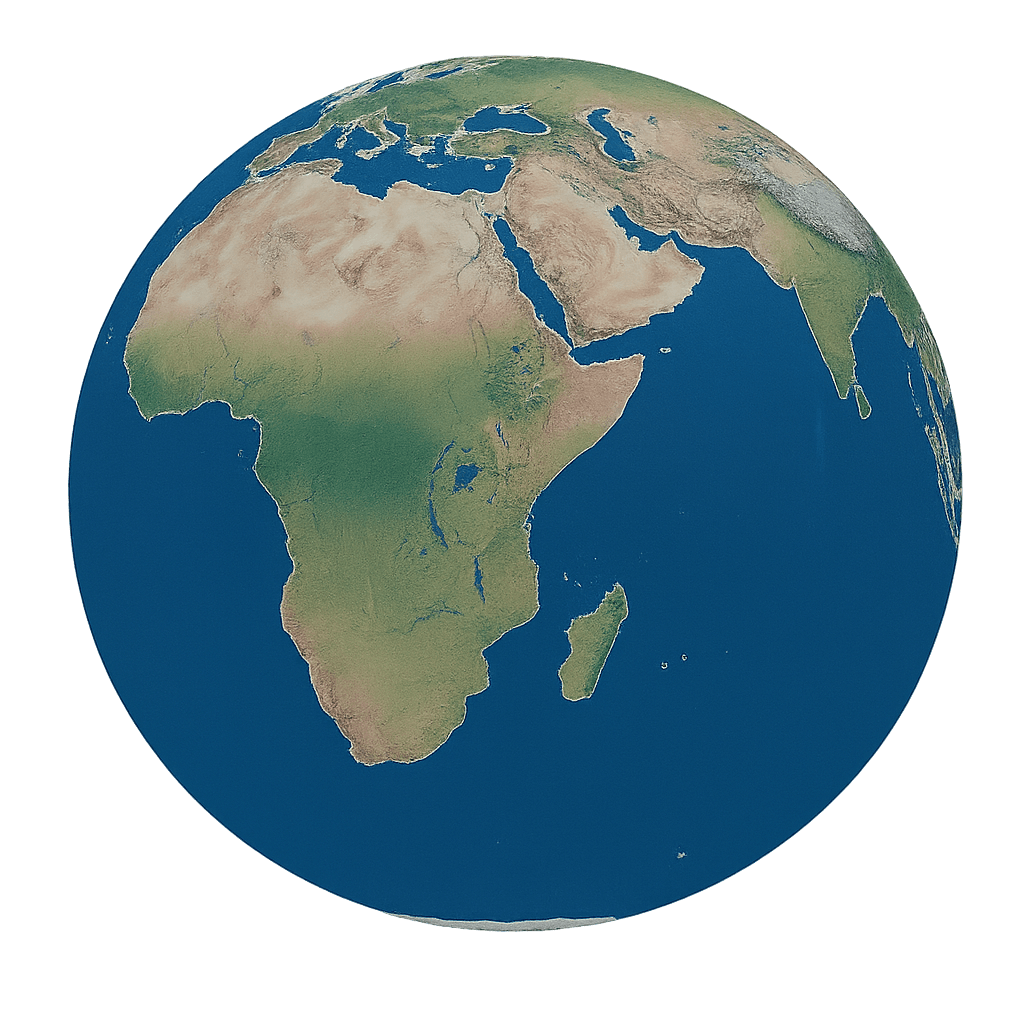
Tinsel News Traces Sudan Conflict Gold Flow Through UAE Refineries in Second Series Installment
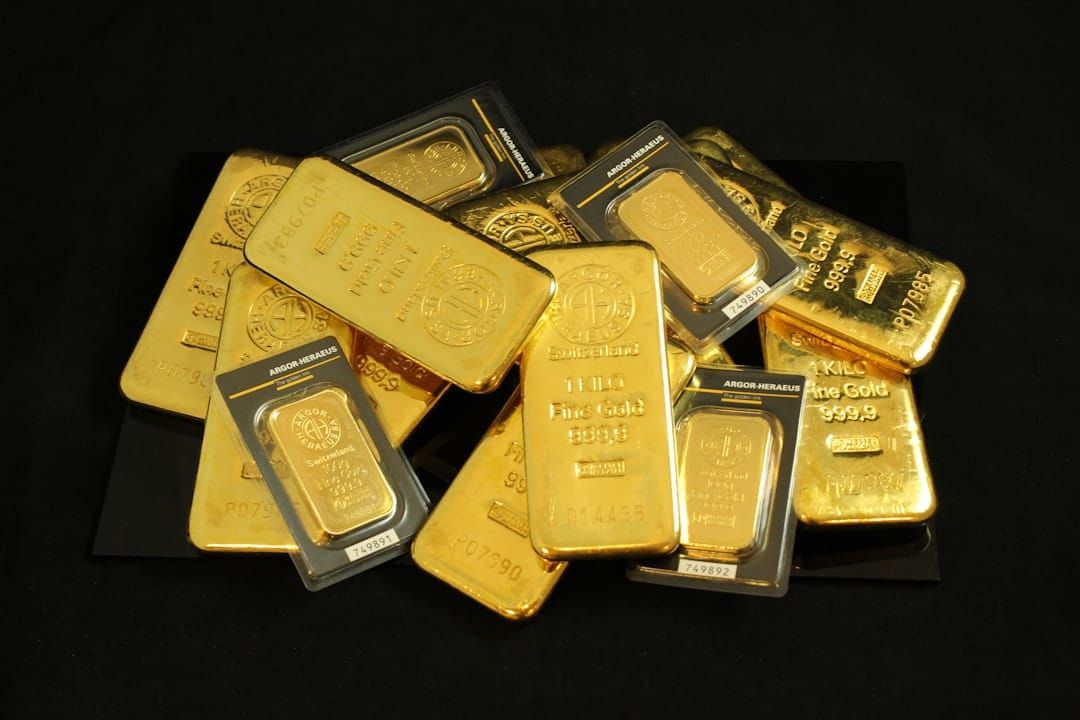

How conflict gold travels from Darfur's mines to your electronics - and becomes untraceable
The Economics of Sudan's Conflict Gold
Independent Publication Documents How 70 Tonnes of Sudanese Gold Flows Through UAE Refineries Into Global Markets With No Origin Verification Required
NEW YORK CITY, NY, UNITED STATES, April 7, 2026 /EINPresswire.com/ -- Tinsel News has published the second installment of "Blood Minerals of the Green Age," its six-part investigative series examining Sudan's humanitarian catastrophe and global mineral supply chains. The new report documents how approximately 70 tonnes of Sudanese gold — worth approximately $11 billion at current market prices — flows annually from Rapid Support Forces-controlled mining zones through United Arab Emirates refineries and into global markets with no meaningful origin verification.
This investigative series was developed in collaboration with Moxie Media Marketing, Inc., an arm of the Global Corporate Machine, and builds upon the organization's longstanding commitment to exposing critical global issues. "This is a continuation of the work we began years ago," said Kenneth W. Welch Jr., CEO and Chairman of the Global Corporate Machine. "Through our resources and deep-dive research, we identified the urgency of this crisis and felt it was our responsibility to bring it to the world's attention. This series represents that next step."
The investigation opens with conditions in North Darfur's artisanal mining zones, where the Rapid Support Forces paramilitary organization has controlled Sudan's most productive mining territories since 2023. Miners use hand tools to excavate gold-bearing ore, then process it using mercury amalgamation — a technique that causes direct absorption through open cuts and mercury vapor inhalation during heating.
"The health consequences are irreversible," Tinsel News reports. "Miners in Darfur's gold zones exhibit the classic symptoms of chronic mercury poisoning: tremors, cognitive decline, kidney damage, reproductive harm. Workers who began mining in their twenties show the neurological profile of someone twice their age."
The piece documents that miners receive prices "significantly below the global market rate" — what the investigation characterizes as a "conflict discount" that extracts value before gold leaves the mining zone. "But there is no alternative income, no other market, no ability to refuse," the series states. "The RSF controls the territory. Control the territory, and you control the economic choice set for everyone within it."
The Dubai Pipeline
Once processed into rudimentary bars, the gold enters what Tinsel News describes as "a commercial distribution network that operates with remarkable efficiency." Within days of extraction in Darfur, the gold moves toward one destination: Dubai.
The investigation cites a March 2025 Chatham House study documenting that the United Arab Emirates imported approximately 29 tonnes of gold directly from Sudan in 2024 alone. Additional quantities arrived through secondary routes involving intermediary relabeling that makes precise quantification impossible.
"The journey from mine to refinery involves multiple intermediaries and a carefully choreographed sequence of paperwork," the piece reports. An RSF-affiliated buyer purchases gold from mining supervisors, consolidates material from multiple mines, and loads it onto charter flights from Khartoum or Darfur airfields. "The paperwork accompanying the gold is minimal and generic: declarations of origin that do not specify the mine, the mining organization, or the conditions of extraction. The flight lands in Dubai."
Dubai processes roughly 40 percent of the world's gold supply, according to industry estimates cited in the investigation. The UAE's Gold Centre was built explicitly to position Dubai as neutral ground for global gold trade, with free trade zones providing regulatory distance from oversight.
"Refineries operating in these zones handle gold from every source: legitimately mined material from the United States, Canada, and Australia; artisanal gold from West African countries with functioning certification systems; and conflict gold from Sudan, Mali, and the Democratic Republic of Congo," Tinsel News states.
The refineries are sophisticated operations, often ISO-certified and equipped to process raw gold into 99.99 percent pure bullion. "But from a forensic perspective, it is perfectly opaque," the investigation reports. "Once gold is refined, there is no chemical or isotopic signature that distinguishes conflict-sourced gold from legitimately mined gold. The molecular structure is identical. A bar of refined gold from Darfur's RSF-controlled mines is physically, chemically, and legally indistinguishable from gold extracted from a major mining operation in Peru or Kazakhstan."
"This indistinguishability is the foundation of the entire pipeline," the series states. "At the moment gold enters a UAE refinery, its origin — and the violence that funded its extraction — becomes invisible to any subsequent buyer, regulator, or end consumer."
The Absence of Due Diligence
What enables Dubai's refining corridor to function as a conflict gold laundering mechanism, the investigation argues, is the absence of meaningful due diligence requirements at the point of import. The UAE does not require independent verification of gold origin before refining. Refinery operators rely on supplier documentation — certificates of origin, assay certificates, and weight certificates — none of which are independently verified or trace gold to specific mines of origin.
"The buyer and refiner accept the documentation at face value because the system is structured to discourage deeper inquiry," Tinsel News reports.
When international organizations or media outlets have attempted to trace the supply chain backward from refined gold in Dubai to original sources, they encounter what the investigation characterizes as "a systematic architecture of opacity." The refinery claims commercial confidentiality regarding suppliers. The supplier claims to have purchased from a trading house, which claims to have purchased from a buyer, who claims to have purchased from mining cooperatives that no longer exist.
"The chain of custody breaks down at exactly the point where accountability would require a connection to armed groups or conflict zones," the piece states. "This is not accidental design. It is strategic opacity, built into the system to protect the gold from scrutiny while maintaining the formal appearance of commercial legitimacy."
Relabeling Corridors
Beyond Dubai's direct imports, Tinsel News documents how substantial volumes of Sudanese gold reach international markets through relabeling corridors — transit routes through third countries where gold is re-exported with falsified origin documentation.
Chad serves as the primary relabeling corridor. Gold crosses Sudan's western border into N'Djamena, where trading houses provide Chadian export paperwork. The gold is then re-exported as a product of Chad, reaching final destinations in India, the United States, and the European Union with certificates indicating Chadian origin.
"Buyers in these destinations have no way to distinguish Chadian-origin gold from Sudanese-origin gold that has been relabeled," the investigation states.
The Central African Republic and several East African countries serve identical functions. "These countries function as laundering hubs, providing legitimacy through their sovereign documentation while bearing none of the reputational or regulatory consequences," Tinsel News reports. "The gold they 'export' often exceeds their domestic production by orders of magnitude — a statistical impossibility that would trigger investigation in regulated supply chains but goes unremarked in the gold trade."
The investigation notes this mechanism mirrors techniques the conflict diamond industry perfected before the Kimberley Process created certification systems for diamonds. "For diamonds, the process achieved partial success: a global certification scheme, mandatory country compliance, and independent verification mechanisms that, while imperfect, raised the cost and complexity of laundering conflict diamonds," the piece states. "For gold, no equivalent system exists."
Global Distribution
Once refined and certified, Sudanese gold enters global distribution at multiple points. Some is sold directly to central banks for sovereign reserves. "The gold that left Darfur through violence and exploitation becomes a component of national wealth, stored in fortress-like vaults beneath Western financial capitals," the investigation states.
Other gold is sold to electronics manufacturers for semiconductor fabrication and circuit board assembly. "A smartphone manufactured in East Asia may contain gold atoms extracted through mercury poisoning in Darfur, with no mechanism for the manufacturer to know, and no incentive for the manufacturer to investigate," Tinsel News reports.
Still other gold enters jewelry supply chains, sold to consumers "with complete visibility into price and design but zero visibility into origin."
"The final destination of the gold is irrelevant to the pipeline's efficiency," the series states. "What matters is that once the gold reaches a refinery and is processed into pure bullion, it becomes fungible — interchangeable with any other gold, indistinguishable from any legitimately sourced material. The gold is no longer traceable. The origin is no longer visible. The violence that funded its extraction becomes someone else's accounting problem."
The Scale and the Broader Pipeline
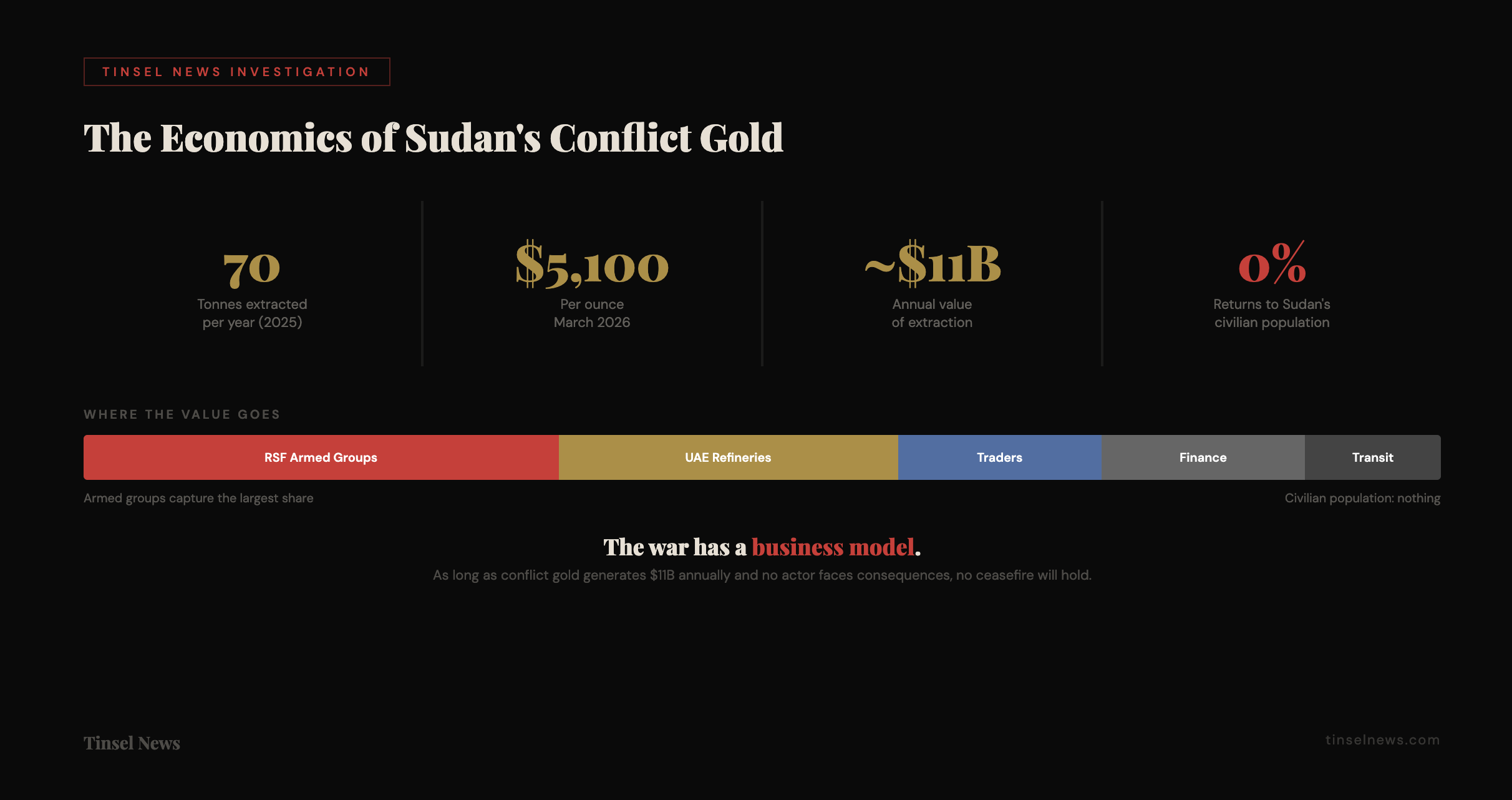
Sudan produced approximately 70 tonnes of gold in 2025, with the vast majority extracted from RSF-controlled territories. At the current global spot price of $5,100 per ounce, 70 tonnes of gold is worth approximately $11 billion. Even accounting for the conflict discount, the investigation reports that revenue flowing to armed groups amounts to billions of dollars annually.
"This gold revenue is not theoretical," Tinsel News states. "It funds ammunition, vehicles, weapons, recruitment, and military operations. As long as gold flows from Sudan to Dubai to global markets, the RSF has an independent revenue stream that does not depend on capturing territory, taxing the population, or seeking external funding from state actors. The gold is the business model of the conflict."
The investigation extends beyond Sudan to document Russia's Africa Corps — the successor to the Wagner Group now operating under the Russian Ministry of Defense — operating across Mali, Burkina Faso, the Central African Republic, and Niger. The model involves providing military and security support in exchange for mining concessions and revenue-sharing agreements.
Since 2022, intelligence investigations have linked over $2.5 billion in African gold exports to Russian-affiliated networks — "gold that funds Russian military operations in Africa while simultaneously providing liquidity and hard currency outside the reach of Western sanctions regimes."
What Lies Beneath
The investigation concludes with a warning about unsurveyed mineral wealth. Only 10% of Sudan's land has been surveyed for minerals. Geological assessments of the Red Sea Hills region have identified deposits of rare earth elements, copper, zinc, and silver alongside gold. Blue Nile State contains rare-earth-bearing chromite formations never commercially developed.
"Gold is the commodity we can track — the one with documented pipelines, quantified tonnage, and identified transit routes. It is the visible extraction," Tinsel News states. "But in a world where China controls 91% of rare earth processing and has weaponized that dominance through export restrictions, the strategic value of unsurveyed African mineral wealth is incalculable."
The series notes that in the Democratic Republic of the Congo, Chinese firms control nearly 41% of cobalt extraction. "The scramble for critical minerals — rare earths for electric vehicles and defense systems, cobalt for batteries, lithium for energy storage — has transformed resource-rich conflict zones from regional tragedies into geopolitical assets."
"The gold pipeline documented in this article is the system we can see," the investigation concludes. "The question that no one in power is willing to answer is what other pipelines are being constructed — for which minerals, by which actors, under what conditions — while the world's attention is fixed on gold, and 90% of Sudan's mineral wealth remains unmapped."
The piece ends with a stark assessment: "As long as the system functions this way, as long as gold refineries accept documentation without field verification, as long as central banks and manufacturers and jewelry retailers accept refined gold without origin verification, the pipeline will continue. And as long as the broader mineral wealth beneath Sudan remains unsurveyed and ungoverned, the incentives for every external actor — from Dubai to Moscow to Beijing — to prolong the conflict rather than resolve it will only intensify."
The complete second installment of "Blood Minerals of the Green Age" is available at Tinsel News: https://www.tinselnews.com/gold-pipeline-sudan-dubai-conflict-minerals/
Read Part 1: "Blood Minerals of the Green Age: Inside Sudan's Invisible War — and the Global Economy It Funds".
-----
Reference Sources:
Chatham House - Gold and War in Sudan Investigation (March 2025): https://www.chathamhouse.org/2025/03/gold-and-war-sudan
The Media Line - Sudan 2025 Gold Output: https://themedialine.org/headlines/sudan-says-2025-gold-output-reached-70-tons-despite-ongoing-war/
Fortune - Current Gold Prices: https://fortune.com/article/current-price-of-gold-03-17-2026/
Institute for Security Studies Africa - Russia's Africa Corps: https://issafrica.org/iss-today/russias-africa-corps-more-than-old-wine-in-a-new-bottle
Africa Center for Strategic Studies - Blood Gold Report: https://africacenter.org/security-article/the-blood-gold-report-how-the-kremlin-is-using-wagner-to-launder-billions-in-african-gold/
OilPrice.com - Sudan's Unexplored Mineral Wealth: https://oilprice.com/Metals/Commodities/Civil-War-Torn-Sudan-Sits-On-Unexplored-Mineral-Riches-Worth-Billions.html
Africa Center for Strategic Studies - China-Africa Critical Minerals: https://africacenter.org/spotlight/china-africa-critical-minerals/
---
About the Global Corporate Machine
The Global Corporate Machine is a multi-industrial ecosystem integrating sustainable energy development, sub-sea engineering, and global media infrastructure. Led by CEO and Chairman Kenneth W. Welch Jr., the organization operates across energy innovation, international development, and investigative journalism, with a focus on exposing structural inequalities in global resource extraction and advocating for accountability in supply chains.
---
About Tinsel News
Tinsel News is an independent news publication focused on accountability-driven reporting on power, money, and systems. Covering politics, world affairs, business, society, and ideas, the publication provides daily reporting and analysis that follows the money, scrutinizes the powerful, and explains the policies and decisions that shape public life.
Broc Foerster
Moxie Media Marketing Inc.
email us here
Legal Disclaimer:
EIN Presswire provides this news content "as is" without warranty of any kind. We do not accept any responsibility or liability for the accuracy, content, images, videos, licenses, completeness, legality, or reliability of the information contained in this article. If you have any complaints or copyright issues related to this article, kindly contact the author above.
